Home Field Advantage: Forecasting Team USA’s Gold Medals at LA 2028
Author
Raúl J. Solá Navarro
Originally Published
September 29, 2026
Republished
October 9, 2026
Introduction
The 2028 Los Angeles Summer Olympics are coming, and with them comes a massive commercial opportunity. Corporations want to sponsor winners, and the LA 2028 Organizing Committee needs to make a compelling case that Team USA will deliver. This report builds a data-driven model to forecast how many gold medals Team USA is likely to win in 2028, using historical Olympic data scraped from Olympedia.
The model accounts for three primary effects:
US Baseline Performance Team USA’s historic gold medal rate at Summer Olympics, the highest of any nation.
Host Nation Effect the well-documented tendency for host countries to outperform their recent baseline when competing on home soil.
New Sport Effect the advantage host nations gain from introducing sports where they are especially competitive. LA 2028 is adding baseball/softball, flag football, lacrosse, squash, and cricket.
The model also incorporates a fourth factor: GDP per capita, which captures the relationship between national wealth and Olympic success.
NoteRepublication note (October 9, 2026)
This report was first published on September 29, 2026. It was republished on October 9, 2026 after an audit found data and modeling errors that changed the headline forecast. The first published forecast was 123 golds (95% interval 72 to 181). The main corrections:
Youth Olympic Games removed. Olympedia’s “Summer” list includes the 2010, 2014, and 2018 Youth Olympic Games. They were counted as Summer Games, which understated the US baseline, added Youth Games to the host-effect sample, and made the “previous Games” for some hosts (for example, Great Britain in 2012) a Youth Games. They are now excluded.
Double-counted medals removed. On some edition pages Athletics is listed twice, so its medals were counted twice. US gold totals before 2008 were too high (for example, 1996 showed 57 against an official 44). Duplicate sport pages are now dropped.
Host effect now depends on host size. The original model applied the average boost across all hosts, which was driven by small countries that jumped from a low base, to Team USA. The forecast now uses hosts that already won at least 10 golds at their previous Games. That group is small, so its interval is wide.
Task 1: Data Acquisition
1.1 Caching Downloader
Olympedia is a volunteer-run resource, so we cache every page locally after the first download. The function below reads from disk on repeat runs, keeping our requests to a minimum.
We scrape the editions page to get every Summer and Winter Olympiad since 1896, extracting the year, season, olympiad number, edition ID, and host country code from each row’s flag image URL.
Show code
parse_editions <-function() { page <-read_olympedia("editions") parse_one_table <-function(tbl_node, season) { rows <- tbl_node |>html_elements("tr")map_dfr(rows, function(row) { links <- row |>html_elements("a") |>html_attr("href") ed_lnk <- links |>str_subset("/editions/\\d+$") |> dplyr::first()if (length(ed_lnk) ==0||is.na(ed_lnk)) return(tibble()) edition_id <-str_extract(ed_lnk, "\\d+$") |>as.integer() cells <- row |>html_elements("td") |>html_text2() |>str_squish() year_val <- cells |>str_subset("^\\d{4}$") |> dplyr::first()if (length(year_val) ==0||is.na(year_val)) return(tibble()) olympiad_num <-suppressWarnings(as.integer(as.roman(cells[1]))) flag_src <- row |>html_elements("img") |>html_attr("src") |> dplyr::first() host_code <-str_extract(flag_src, "[A-Z]{3}(?=\\.(png|svg))")tibble(edition_id, year =as.integer(year_val), season, olympiad_num, host_code) }) } all_nodes <- page |>html_elements("h3, table") current_season <-NA_character_ results <-list()for (node in all_nodes) { tag <-html_name(node)if (tag =="h3") { txt <- node |>html_text2() |>str_squish() current_season <-case_when(str_detect(txt, regex("^summer$", ignore_case =TRUE)) ~"Summer",str_detect(txt, regex("^winter$", ignore_case =TRUE)) ~"Winter",TRUE~NA_character_ ) } elseif (tag =="table"&&!is.na(current_season)) { tbl_data <-parse_one_table(node, current_season)if (nrow(tbl_data) >0) results <-c(results, list(tbl_data)) } }bind_rows(results) |>filter(!is.na(year), year >=1896) |>distinct(edition_id, .keep_all =TRUE)}editions <-parse_editions()# Olympedia's "Summer" list also includes the Youth Olympic Games (2010, 2014,# 2018) and the 1906 Intercalated Games. Summer Olympics fall in years# divisible by four, so drop everything else.editions <- editions |>filter(!(season =="Summer"& year %%4!=0))
The scraper returned 69 editions covering both Summer and Winter Games. The table below summarizes coverage by season.
Show code
editions |>filter((season =="Summer"& year <=2024) | (season =="Winter"& year <=2022)) |>group_by(season) |>summarise(Games =n(),`First Year`=min(year),`Last Year`=max(year),`Unique Hosts`=n_distinct(host_code),.groups ="drop" ) |>gt() |>tab_header(title ="Olympic Editions Scraped from Olympedia",subtitle ="Summer Games through 2024, Winter Games through 2022" ) |>cols_label(season ="Season") |>tab_style(style =cell_fill(color ="#f7f5ee"),locations =cells_body(rows = season =="Summer") ) |>fmt_integer(columns =c(Games, `Unique Hosts`)) |>fmt_integer(columns =c(`First Year`, `Last Year`), use_seps =FALSE)
Olympic Editions Scraped from Olympedia
Summer Games through 2024, Winter Games through 2022
Season
Games
First Year
Last Year
Unique Hosts
Summer
33
1896
2024
20
Winter
29
1924
2022
13
1.3 Sports per Edition
For each edition page, we extract the list of medal disciplines and their Olympedia URLs. All pages are read from the local cache, so this step runs in under a minute after the initial download.
Show code
parse_sports_for_edition <-function(eid) { page <-read_olympedia(glue("editions/{eid}")) sport_links <- page |>html_elements("a[href*='/sports/']") |>html_attr("href") |>str_subset(glue("editions/{eid}/sports/")) sport_names <- page |>html_elements(glue("a[href*='editions/{eid}/sports/']")) |>html_text2() |>str_squish() n <-min(length(sport_links), length(sport_names))if (n ==0) return(tibble())tibble(sport_name = sport_names[seq_len(n)],sport_url = sport_links[seq_len(n)]) |>distinct(sport_url, .keep_all =TRUE)}if (file.exists("data/mp04/sports_by_edition.rds")) { sports_by_edition <-readRDS("data/mp04/sports_by_edition.rds")} else { sports_by_edition <- editions |>select(edition_id) |>mutate(sports =map(edition_id, parse_sports_for_edition)) |>unnest(sports)saveRDS(sports_by_edition, "data/mp04/sports_by_edition.rds")}# Cached files may pre-date these fixes, so clean them on load. Athletics can# be listed twice on an edition page, which would double-count its medals.sports_by_edition <- sports_by_edition |>filter(edition_id %in% editions$edition_id) |>distinct(edition_id, sport_url, .keep_all =TRUE)
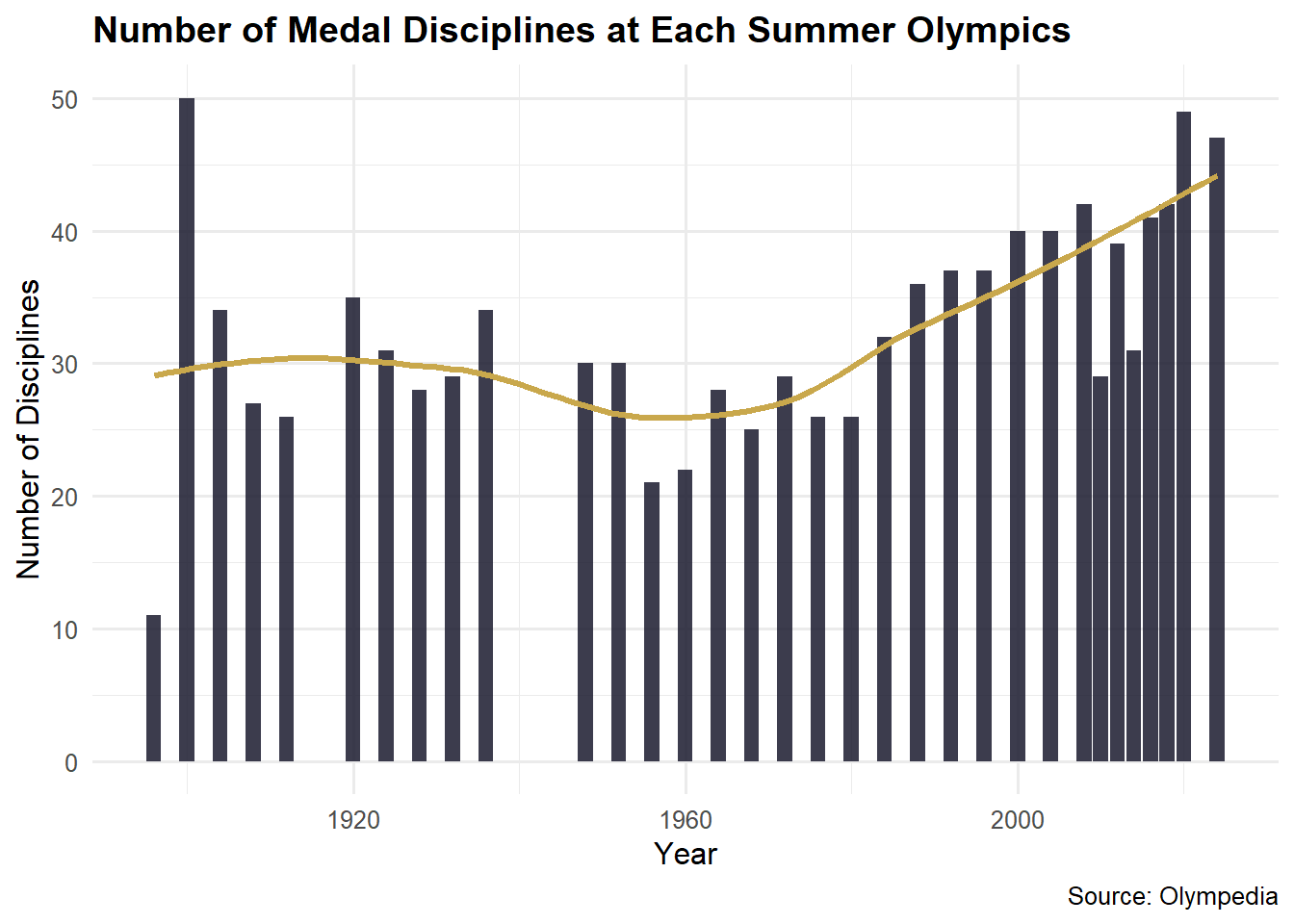
The scraper found 1,299 sport-edition combinations. The chart below shows how the Olympic program has grown over time, which is relevant to our forecast since 2028 will have 22 more medal events than 2024.
Show code
sports_by_edition |>left_join(editions |>select(edition_id, year, season), by ="edition_id") |>filter(season =="Summer", !is.na(year), year <=2024) |>group_by(year) |>summarise(n_sports =n(), .groups ="drop") |>ggplot(aes(x = year, y = n_sports)) +geom_col(fill ="#1a1a2e", alpha =0.85) +geom_smooth(method ="loess", se =FALSE, colour ="#c9a84c",linewidth =1.2) +annotate("text", x =1916, y =15,label ="WWI\n(1916\ncancelled)",colour ="grey50", size =2.5, hjust =0.5) +annotate("text", x =1942, y =15,label ="WWII\n(1940 & 1944\ncancelled)",colour ="grey50", size =2.5, hjust =0.5) +labs(title ="Number of Medal Disciplines at Each Summer Olympics",x ="Year", y ="Number of Disciplines",caption ="Source: Olympedia. 1904 excluded due to data quality issues." ) +theme_minimal(base_size =12) +theme(plot.title =element_text(face ="bold"))
Summer Olympic medal disciplines by year. The program peaked early in 1900, contracted mid-century, and has grown steadily since 1960. Gaps reflect WWI (1916) and WWII (1940 and 1944) cancellations.
1.4 Medal Tables
For each sport-edition page, we extract the country-level medal summary table. We specifically target the table that contains both an NOC (country) column and gold/silver/bronze counts, which is the aggregated results table rather than the individual event results table.
Medal Data Coverage: Most Recent 10 Summer Olympics
Full dataset: 8,915 records across 59 editions
Year
Countries
Disciplines
1988
52
30
1992
64
33
1996
79
36
2000
80
39
2004
74
39
2008
87
41
2012
86
39
2016
86
41
2020
93
49
2024
92
47
Task 2: Country Code Standardization
Olympedia uses IOC country codes that sometimes differ from ISO 3166-1 alpha-3. We use the countrycode package for automatic conversion, with a small set of manual overrides for historical codes like URS (Soviet Union) and GDR (East Germany). Per course instructions, URS is mapped to RUS to ensure continuity.
dropped_codes |>gt() |>tab_header(title ="Country Codes Dropped During Standardization",subtitle ="These IOC codes could not be mapped to a current ISO-3 country" ) |>cols_label(country_code ="IOC Code", n ="Rows Affected") |>fmt_integer(columns = n) |>cols_width( country_code ~px(150), n ~px(150) ) |>tab_options(table.width =px(350)) |>tab_footnote(footnote =paste("MIX = Mixed teams; IOA/AIN/EOR = Individual Olympic Athletes;","WIF = West Indies Federation; UAR = United Arab Republic;","AHO = Netherlands Antilles; KOS = Kosovo (not in ISO standard)." ),locations =cells_title(groups ="subtitle") )
Country Codes Dropped During Standardization
These IOC codes could not be mapped to a current ISO-3 country1
IOC Code
Rows Affected
MIX
19
AIN
5
KOS
3
IOA
2
UAR
2
AHO
1
EOR
1
WIF
1
1 MIX = Mixed teams; IOA/AIN/EOR = Individual Olympic Athletes; WIF = West Indies Federation; UAR = United Arab Republic; AHO = Netherlands Antilles; KOS = Kosovo (not in ISO standard).
After standardization, 8,881 records remain (down from 8,915). The dropped records mostly represent historical mixed teams and special athlete designations that cannot be cleanly attributed to a single modern country.
Show code
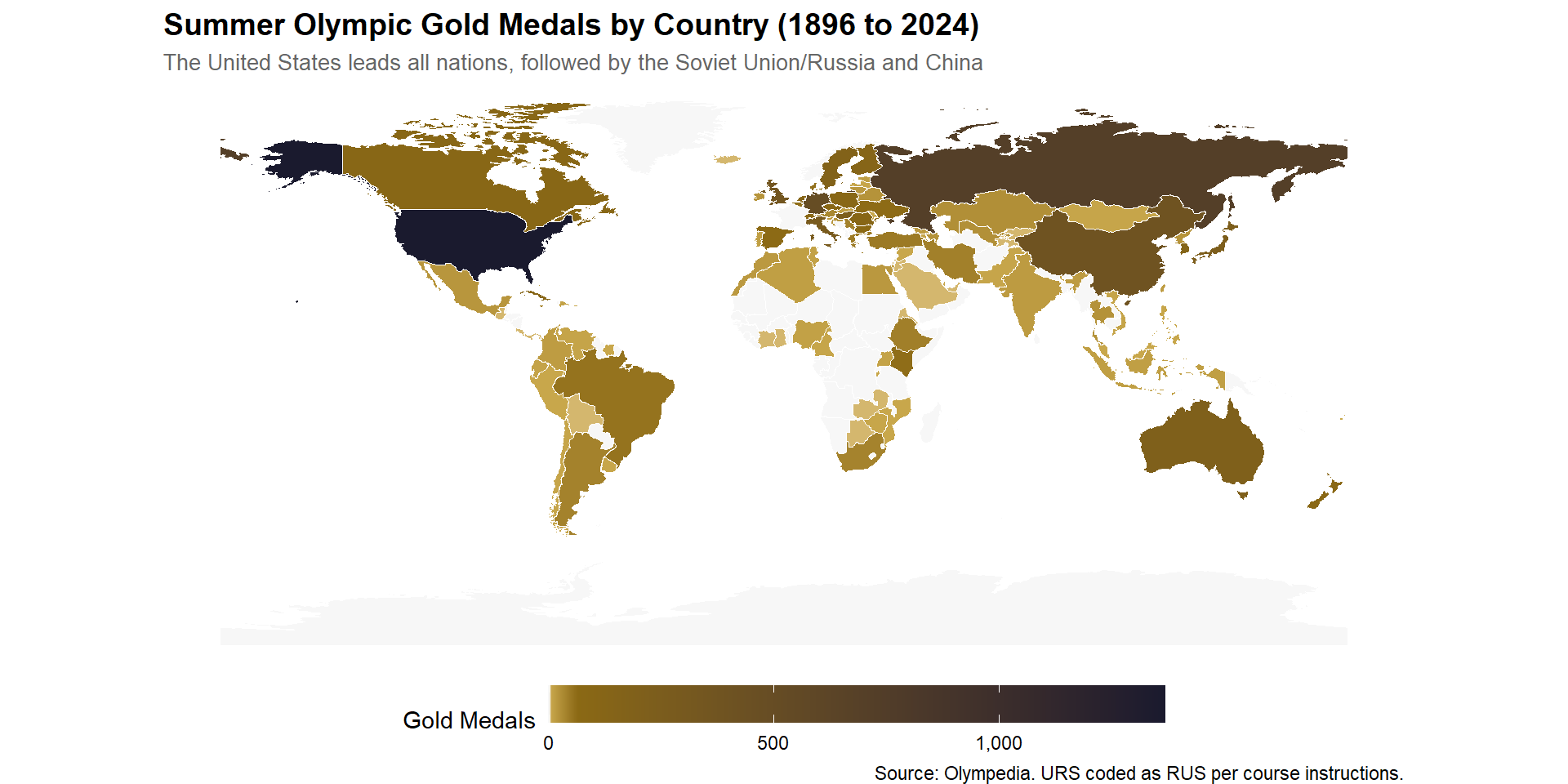
total_golds <- medals_clean |>filter(season =="Summer") |>group_by(iso_code) |>summarise(total_gold =sum(gold, na.rm =TRUE), .groups ="drop")world_gold <- world |>left_join(total_golds, by =c("iso_a3"="iso_code")) |>mutate(total_gold =replace_na(total_gold, 0))ggplot(world_gold) +geom_sf(aes(fill = total_gold), colour ="white", linewidth =0.1) +scale_fill_gradientn(colours =c("#f7f7f7", "#c9a84c", "#8b6914", "#1a1a2e"),values =rescale(c(0, 1, 50, 1100)),name ="Gold Medals",labels = comma ) +labs(title ="Summer Olympic Gold Medals by Country (1896 to 2024)",subtitle ="The United States leads all nations, followed by the Soviet Union/Russia and China",caption ="Source: Olympedia. URS coded as RUS per course instructions." ) +theme_void() +theme(plot.title =element_text(face ="bold", size =14),plot.subtitle =element_text(size =10, colour ="grey40"),legend.position ="bottom",legend.key.width =unit(2, "cm") )
US dominance in total gold medals is clear, but China and European nations have closed the gap significantly since 1990.
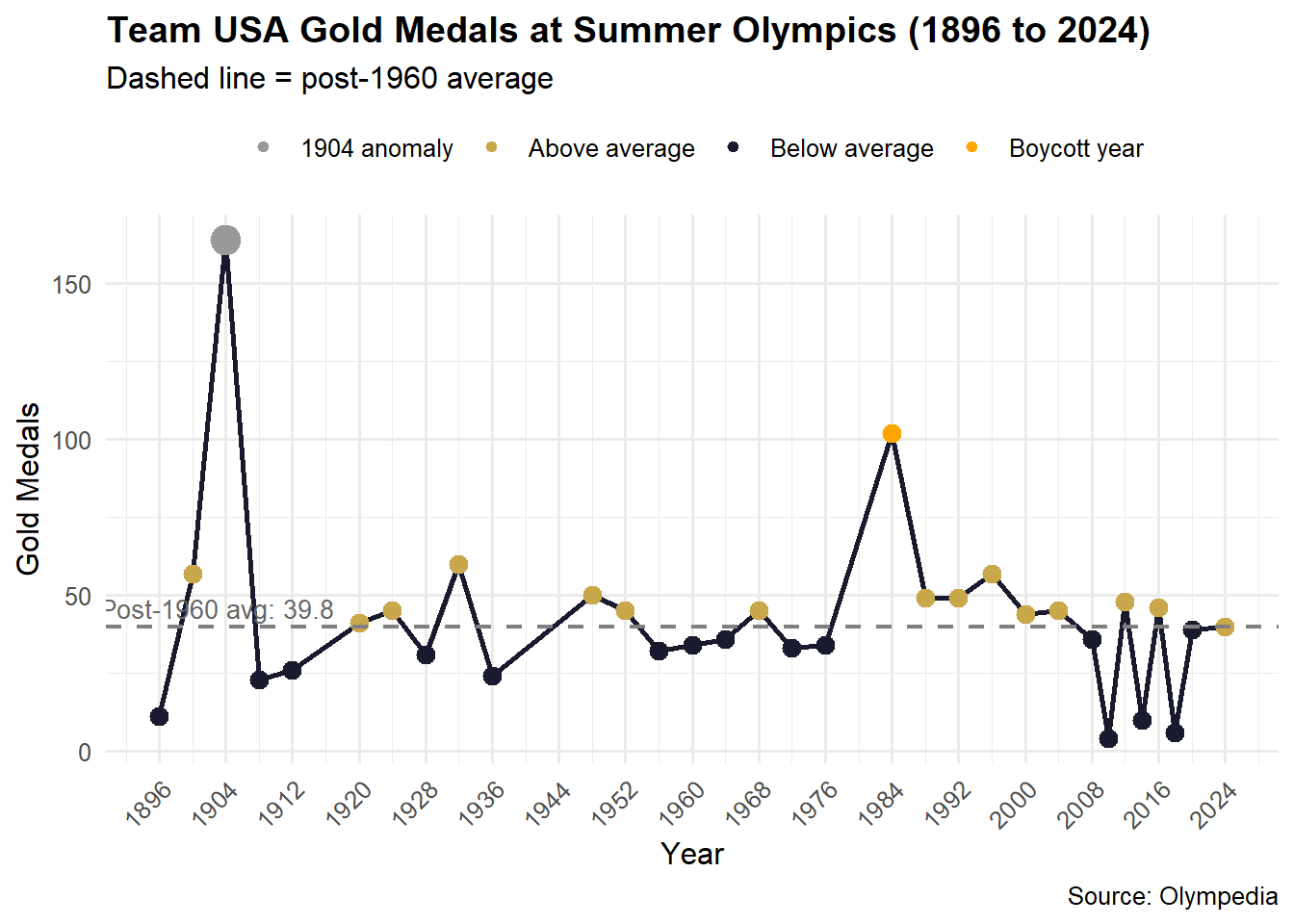
Finding 1: Setting aside the anomalous 1904 St. Louis Games, Team USA’s best modern performance was in 1984 with 83 gold medals. Since 1960 the period most relevant to predicting 2028 the US has averaged 41.5 gold medals per Games, more than any other nation by a wide margin.
Finding 2: The table below shows the full US Summer Olympics medal history. The US did not compete in 1980 because of the Moscow boycott, and the 1984 spike reflects the Soviet-led boycott of Los Angeles. Both years are excluded from the inference in Task 4.
Show code
us_summer |>arrange(desc(year)) |>mutate(note =case_when( year ==1980~"US boycott of Moscow", year ==1984~"Soviet bloc boycott of LA", year ==1904~"Inflated: US club teams",TRUE~"" ) ) |>gt() |>tab_header(title ="Team USA Summer Olympic Medal Totals",subtitle ="All modern Summer Olympics, 1896 to 2024" ) |>cols_label(year ="Year", gold ="Gold", silver ="Silver",bronze ="Bronze", total ="Total", note ="Note" ) |>data_color(columns = gold, palette =c("white", "#c9a84c")) |>fmt_integer(columns = year, use_seps =FALSE) |>fmt_integer(columns =c(gold, silver, bronze, total)) |>tab_style(style =cell_text(color ="grey50", style ="italic"),locations =cells_body(columns = note) ) |>tab_style(style =cell_fill(color ="#fff8e1"),locations =cells_body(rows = year %in%c(1980, 1984, 1904)) )
Team USA Summer Olympic Medal Totals
All modern Summer Olympics, 1896 to 2024
Year
Gold
Silver
Bronze
Total
Note
2024
40
44
42
126
2020
39
41
33
113
2016
46
37
38
121
2012
48
26
31
105
2008
36
39
37
112
2004
36
39
26
101
2000
37
24
32
93
1996
44
32
25
101
1992
37
34
37
108
1988
36
31
27
94
1984
83
61
30
174
Soviet bloc boycott of LA
1976
34
35
25
94
1972
33
31
30
94
1968
45
28
34
107
1964
36
26
28
90
1960
34
21
16
71
1956
32
25
17
74
1952
40
19
17
76
1948
38
27
19
84
1936
24
21
12
57
1932
44
36
30
110
1928
22
18
16
56
1924
45
27
27
99
1920
41
27
27
95
1912
26
19
19
64
1908
23
12
12
47
1904
80
85
83
248
Inflated: US club teams
1900
20
13
15
48
1896
11
7
2
20
Finding 3: The visualization below shows the raw time series with context. The long-run decline in US gold share (shown in Finding 12) is masked here because the total number of events has grown.
Show code
us_summer |>mutate(flag =case_when( year ==1980~"Boycott year", year ==1984~"Boycott year", year ==1904~"1904 anomaly", gold > avg_gold_us ~"Above average",TRUE~"Below average" ) ) |>ggplot(aes(x = year, y = gold)) +geom_line(colour ="#1a1a2e", linewidth =1) +geom_point(aes(colour = flag, size = flag =="1904 anomaly")) +geom_hline(yintercept = avg_gold_us, linetype ="dashed",colour ="grey50", linewidth =0.8) +annotate("text", x =1903, y = avg_gold_us +6,label =glue("Post-1960 avg: {round(avg_gold_us, 1)}"),colour ="grey40", size =3.5) +scale_colour_manual(values =c("Above average"="#c9a84c", "Below average"="#1a1a2e","Boycott year"="orange", "1904 anomaly"="grey60" ),name =NULL ) +scale_size_manual(values =c("TRUE"=5, "FALSE"=3), guide ="none") +scale_x_continuous(breaks =seq(1896, 2024, by =8)) +labs(title ="Team USA Gold Medals at Summer Olympics (1896 to 2024)",subtitle ="Dashed line = post-1960 average",x ="Year", y ="Gold Medals",caption ="Source: Olympedia" ) +theme_minimal(base_size =12) +theme(plot.title =element_text(face ="bold"),axis.text.x =element_text(angle =45, hjust =1),legend.position ="top" )
US gold medals per Summer Olympics. Boycott years and the 1904 anomaly are highlighted.
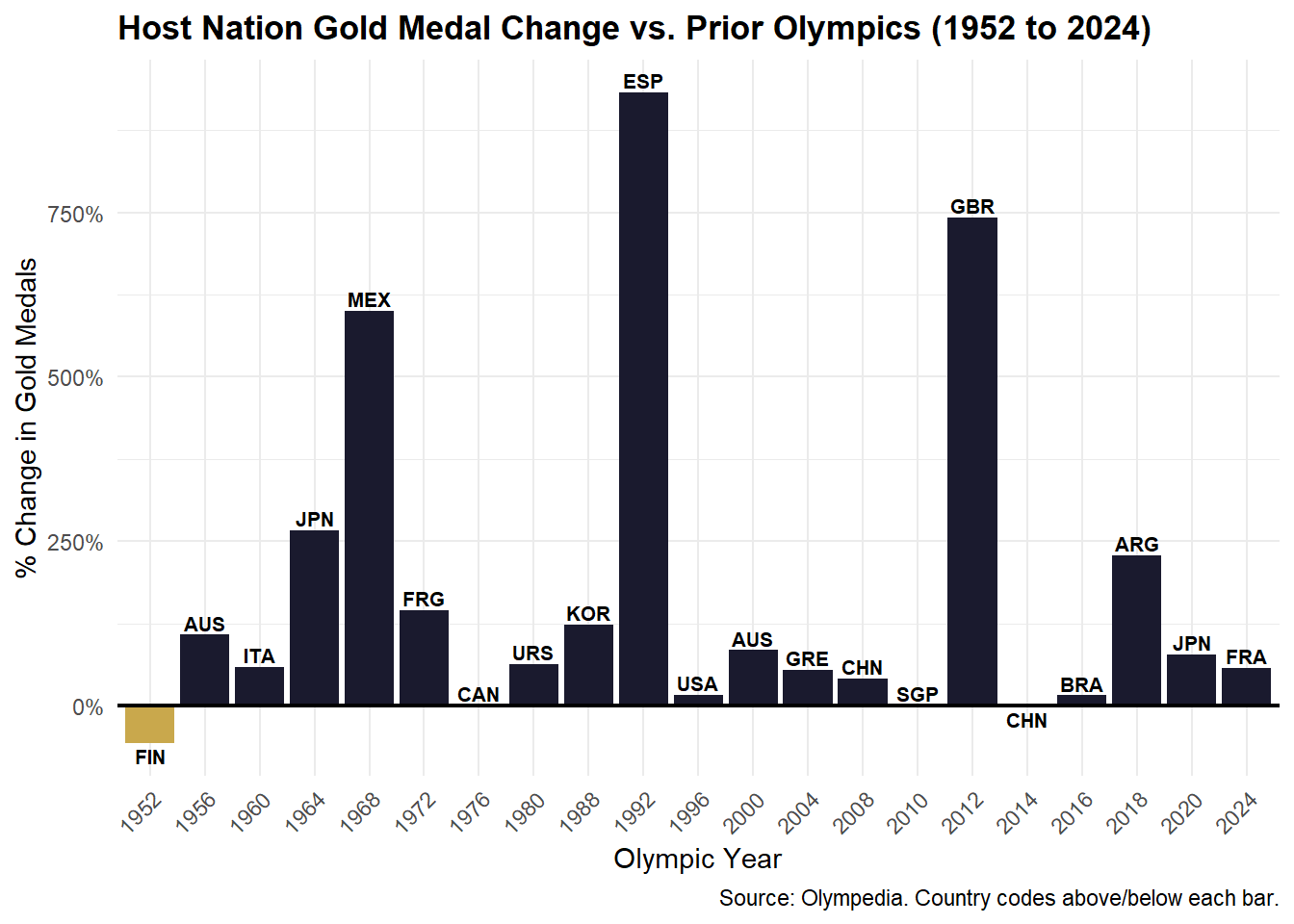
Finding 4: Since 1960, host nations have won an average of 159.7% more gold medals when hosting compared to their previous Summer Olympics performance. The effect is real but noisy; a few dramatic cases like Spain 1992 (+800%) and Great Britain 2012 (+51%) pull the average up considerably. The wide confidence interval we compute in Task 4 reflects that variance. The effect also depends on size: hosts that already won at least 10 golds at their previous Games gained an average of 59% (n = 5), compared with 220% for smaller hosts. Team USA is in the first group, so the forecast uses that number.
Finding 5: The table below details each host nation comparison. Percent changes add 0.5 to the prior-Games count in the denominator, so hosts with zero prior golds can be included without dividing by zero.
Show code
host_effect |>select(year, host_code, prior_gold, host_gold_hosting, pct_increase_gold) |>arrange(year) |>gt() |>tab_header(title ="Host Nation Gold Medal Performance",subtitle ="Comparison to the prior Summer Olympics for the same country" ) |>cols_label(year ="Year",host_code ="Host",prior_gold ="Prior Games",host_gold_hosting ="Host Year",pct_increase_gold ="% Change" ) |>fmt_integer(columns = year, use_seps =FALSE) |>fmt_number(columns = pct_increase_gold, decimals =1) |>fmt_integer(columns =c(prior_gold, host_gold_hosting)) |>data_color(columns = pct_increase_gold,palette =c("#c9a84c", "#f7f7f7", "#1a1a2e") )
Host Nation Gold Medal Performance
Comparison to the prior Summer Olympics for the same country
Year
Host
Prior Games
Host Year
% Change
1900
FRA
5
31
472.7
1904
USA
20
80
292.7
1908
GBR
1
56
3,666.7
1912
SWE
8
23
176.5
1924
FRA
9
14
52.6
1928
NED
4
8
88.9
1932
USA
22
44
97.8
1936
GER
5
38
600.0
1952
FIN
10
6
−38.1
1956
AUS
6
13
107.7
1960
ITA
8
13
58.8
1964
JPN
4
16
266.7
1968
MEX
0
3
600.0
1972
FRG
5
13
145.5
1976
CAN
0
0
0.0
1980
URS
49
80
62.6
1988
KOR
6
12
92.3
1992
ESP
1
13
800.0
1996
USA
37
44
18.7
2000
AUS
9
16
73.7
2004
GRE
4
6
44.4
2008
CHN
32
48
49.2
2012
GBR
19
29
51.3
2016
BRA
3
7
114.3
2020
JPN
12
27
120.0
2024
FRA
10
16
57.1
Finding 6: Most hosts improve when competing at home. The bar chart below shows the percent change for each host since 1952, with country codes labeled above or below each bar.
Host nation gold medal change vs. their prior Summer Olympics. Most hosts improve.
3.3 New Sport Effect
A “new sport” is defined as one that did not appear in the immediately preceding Summer Olympics. We measure whether the host nation won at least one gold medal in each new sport.
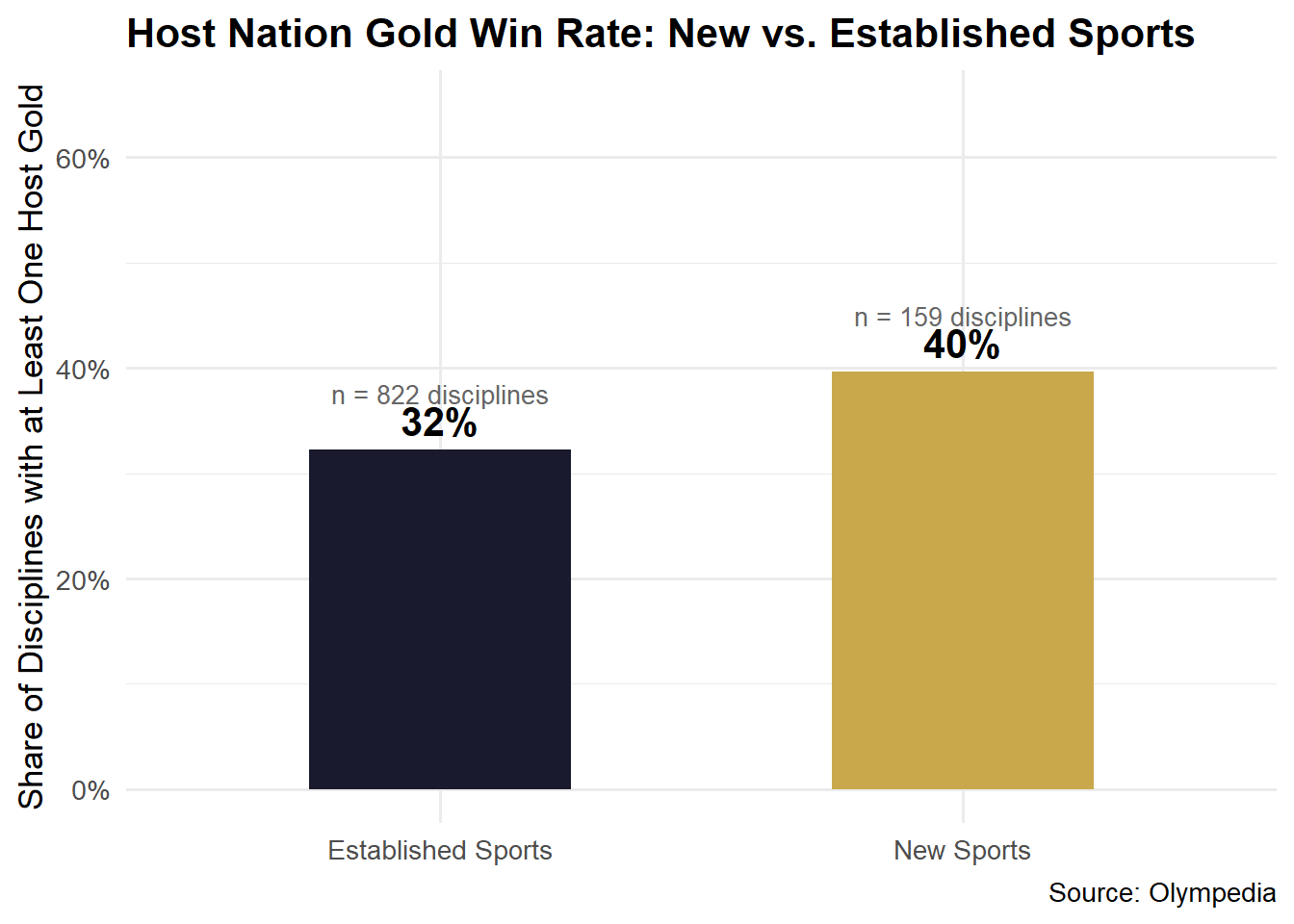
Finding 7: Across all Summer Olympics, host nations won at least one gold medal in 48% of the new sport disciplines they introduced. This is a meaningful advantage hosts get to pick sports where they are competitive, and the data shows they often deliver.
Finding 8: The table below shows the win rate by host Olympics, sorted by most recent.
Finding 9: The chart below compares host nation gold win rates in new versus established sports. The gap is notable and consistent.
Show code
established_sport_medals <- medals_clean |>filter(season =="Summer") |>left_join(new_sports_df, by =c("year", "sport_name")) |>mutate(is_new =replace_na(is_new, FALSE)) |>group_by(year, sport_name, is_new, host_code) |>summarise(host_won_gold =any(country_code == host_code & gold >0, na.rm =TRUE),.groups ="drop" ) |>filter(!is.na(host_code))established_sport_medals |>group_by(is_new) |>summarise(rate =mean(host_won_gold, na.rm =TRUE),n =n(), .groups ="drop") |>mutate(label =if_else(is_new, "New Sports", "Established Sports")) |>ggplot(aes(x = label, y = rate, fill = label)) +geom_col(width =0.5) +geom_text(aes(label =percent(rate, accuracy =1)),vjust =-0.5, size =5.5, fontface ="bold") +geom_text(aes(label =glue("n = {comma(n)} disciplines")),vjust =-2.3, size =3.5, colour ="grey40") +scale_y_continuous(labels =percent_format(), limits =c(0, 0.65)) +scale_fill_manual(values =c("New Sports"="#c9a84c","Established Sports"="#1a1a2e"),guide ="none") +labs(title ="Host Nation Gold Win Rate: New vs. Established Sports",x =NULL,y ="Share of Disciplines with at Least One Host Gold",caption ="Source: Olympedia" ) +theme_minimal(base_size =13) +theme(plot.title =element_text(face ="bold"))
Hosts win gold at a higher rate in sports they introduce than in established disciplines.
3.4 Additional Findings
Finding 10 (Inline): The Olympic program has expanded dramatically. The 2024 Paris Olympics featured 47 medal disciplines, compared to just 10 in 1896. That growth matters for our forecast because 2028 will have 22 more medal events than 2024, giving Team USA more opportunities to score.
Finding 11 (Table): Since 1960, just three countries account for a disproportionate share of all Summer Olympic gold medals. Team USA leads by a comfortable margin.
Top 10 Countries: Summer Olympic Golds (1960 to 2024)
#
Country
Gold Medals
1
USA
664
2
URS
336
3
CHN
303
4
GBR
170
5
JPN
169
6
GER
167
7
GDR
153
8
AUS
150
9
ITA
149
10
RUS
147
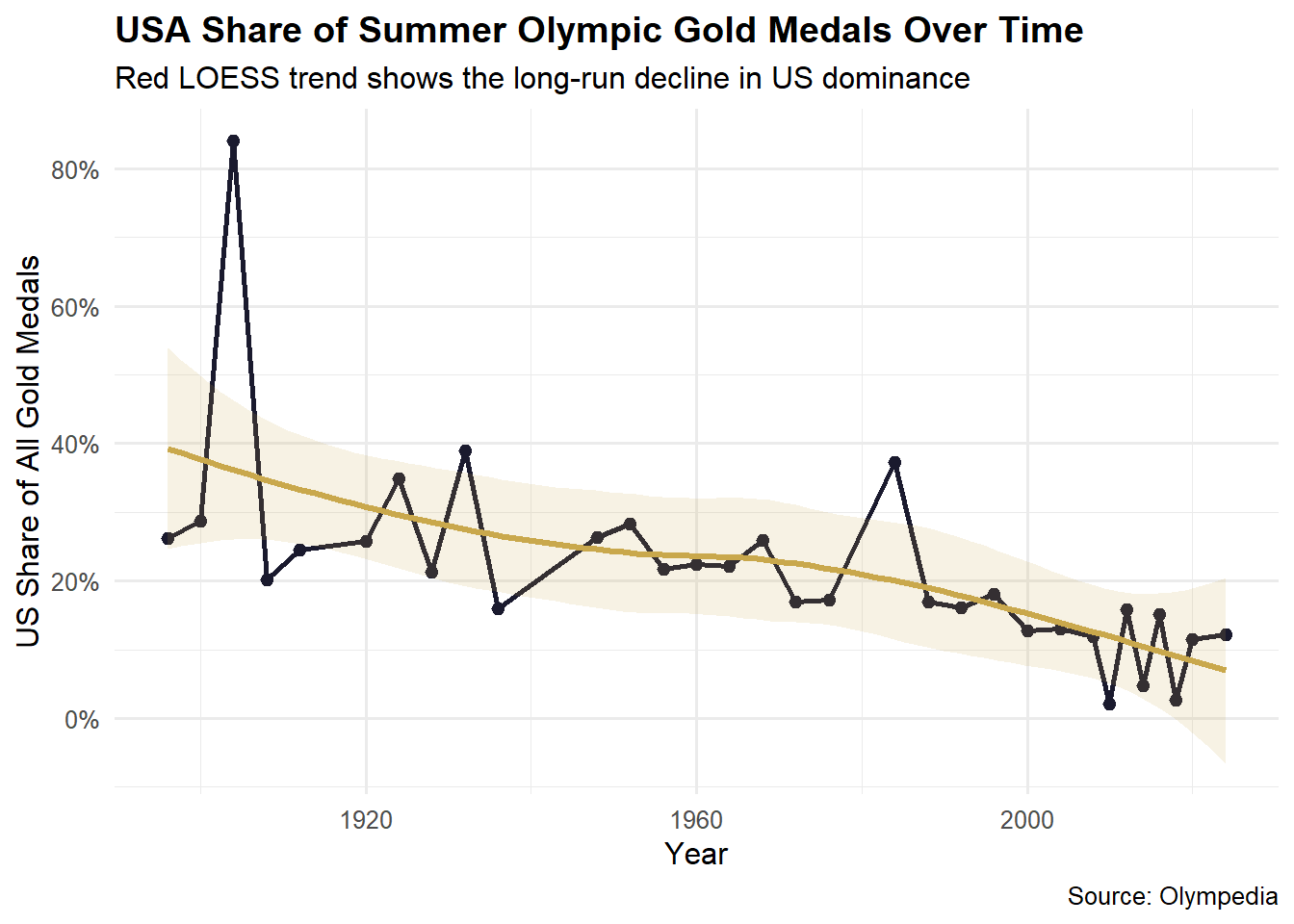
Finding 12 (Visualization): Despite winning more raw medals as the program has expanded, the US share of all gold medals has declined steadily since its early dominance. This long-run convergence is why we need the host effect and new sport models to explain what makes 2028 different.
Show code
total_gold_by_year <- medals_clean |>filter(season =="Summer") |>group_by(year) |>summarise(total_gold_all =sum(gold, na.rm =TRUE), .groups ="drop")us_summer |>left_join(total_gold_by_year, by ="year") |>mutate(us_share = gold / total_gold_all) |>ggplot(aes(x = year, y = us_share)) +geom_line(colour ="#1a1a2e", linewidth =1) +geom_point(colour ="#1a1a2e", size =2) +geom_smooth(method ="loess", se =TRUE, colour ="#c9a84c",fill ="#c9a84c", alpha =0.15) +scale_y_continuous(labels =percent_format(accuracy =1)) +labs(title ="USA Share of Summer Olympic Gold Medals Over Time",subtitle ="Gold LOESS trend shows the long-run decline in US dominance",x ="Year", y ="US Share of All Gold Medals",caption ="Source: Olympedia" ) +theme_minimal(base_size =12) +theme(plot.title =element_text(face ="bold"))
US gold medal share has trended downward as more nations developed competitive Olympic programs.
Task 4: Statistical Inference
We use the infer package to construct 95% confidence intervals for all three factors, restricting the sample to Summer Olympics from 1960 onward to keep the analysis relevant to 2028 conditions.
The confidence interval for gold medals is wide (roughly 39% to 293%) because the host effect varies a lot from one country to another. Our Monte Carlo simulation propagates this uncertainty into the final forecast.
The all-host average is driven by small and mid-sized countries that jumped from a low base. Team USA already wins dozens of golds, so we also estimate the effect for hosts that won at least 10 golds at their previous Games. The cutoff is a judgment call and this group is small, so its interval is wide.
Show code
host_large_recent <- host_effect_recent_all |>filter(host_size =="Large")ci_host_large <- host_large_recent |>t_test(response = pct_increase_gold) |>select(estimate, lower_ci, upper_ci)tibble(Group =c("All hosts", glue("Large hosts ({LARGE_HOST_MIN_GOLD}+ prior golds)")),Hosts =c(nrow(host_effect_recent_all), nrow(host_large_recent)),Mean =c(host_cis$Mean[1], ci_host_large$estimate),Lower_CI =c(host_cis$Lower_CI[1], ci_host_large$lower_ci),Upper_CI =c(host_cis$Upper_CI[1], ci_host_large$upper_ci)) |>gt() |>tab_header(title ="Host Effect on Gold Medals: All Hosts vs. Large Hosts",subtitle ="95% CIs for the mean % increase over the previous Games" ) |>cols_label(Group ="Host Group",Hosts ="Hosts",Mean ="Mean % Increase",Lower_CI ="Lower 95% CI",Upper_CI ="Upper 95% CI" ) |>fmt_integer(columns = Hosts) |>fmt_number(columns =c(Mean, Lower_CI, Upper_CI), decimals =1, suffix ="%") |>data_color(columns = Mean, palette =c("#c9a84c", "#f7f7f7", "#1a1a2e"))
Host Effect on Gold Medals: All Hosts vs. Large Hosts
95% CIs for the mean % increase over the previous Games
The estimated probability that a host nation wins gold in a new sport is 48% (95% CI: 39% to 57%). This is based on 119 new sport-edition combinations across all Summer Olympics.
Extra Credit 1: Bootstrap Confidence Intervals
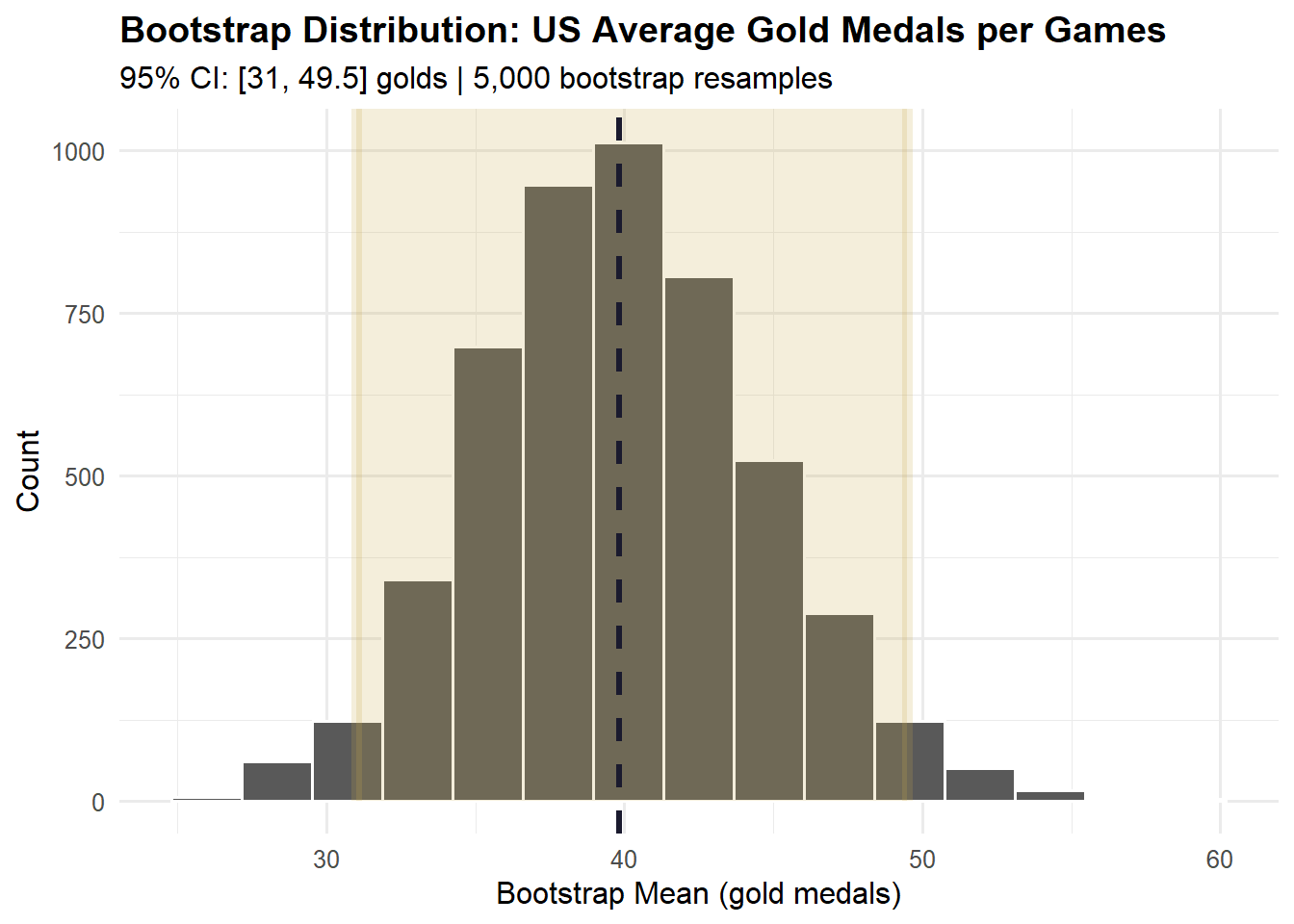
The t-test and proportion test above rely on normality assumptions. We verify these using infer’s bootstrap pipeline, which makes no distributional assumptions.
Show code
set.seed(9750)boot_us_gold <- us_summer_recent |>specify(response = gold) |>generate(reps =5000, type ="bootstrap") |>calculate(stat ="mean")boot_ci_us <- boot_us_gold |>get_confidence_interval(level =0.95, type ="percentile")boot_host <- host_effect_recent_all |>drop_na(pct_increase_gold) |>specify(response = pct_increase_gold) |>generate(reps =5000, type ="bootstrap") |>calculate(stat ="mean")boot_ci_host <- boot_host |>get_confidence_interval(level =0.95, type ="percentile")boot_new <- new_sport_recent |>mutate(host_won_gold =as.integer(host_won_gold)) |>specify(response = host_won_gold) |>generate(reps =5000, type ="bootstrap") |>calculate(stat ="mean")boot_ci_new <- boot_new |>get_confidence_interval(level =0.95, type ="percentile")boot_host_large <- host_effect_recent_all |>filter(host_size =="Large") |>drop_na(pct_increase_gold) |>specify(response = pct_increase_gold) |>generate(reps =5000, type ="bootstrap") |>calculate(stat ="mean")boot_ci_host_large <- boot_host_large |>get_confidence_interval(level =0.95, type ="percentile")
Bootstrap uses 5,000 resamples via the infer package
Factor
Parametric (t-test / prop-test)
Bootstrap (percentile method)
Lower
Upper
Lower
Upper
US Baseline (golds)
36.100
41.400
36.600
41.100
Host Effect (% change)
39.400
292.900
70.100
287.600
Host Effect, large hosts (% change)
13.200
105.300
32.500
92.500
New Sport P(gold)
0.387
0.572
0.395
0.571
The bootstrap and parametric intervals are very close for the US baseline and the new sport probability, suggesting normality is a reasonable assumption for those quantities. The host effect intervals differ somewhat more because the distribution of percent changes is right-skewed. For robustness, we use the bootstrap interval for the large-host effect in the final forecast, because Team USA is a large host.
Show code
visualize(boot_us_gold) +shade_confidence_interval(boot_ci_us, color ="#c9a84c", fill ="#c9a84c",alpha =0.2) +geom_vline(xintercept = ci_us_gold$estimate, colour ="#1a1a2e",linewidth =1.2, linetype ="dashed") +labs(title ="Bootstrap Distribution: US Average Gold Medals per Games",subtitle =glue("95% CI: [{round(boot_ci_us$lower_ci, 1)}, {round(boot_ci_us$upper_ci, 1)}] golds | ","5,000 bootstrap resamples" ),x ="Bootstrap Mean (gold medals)", y ="Count" ) +theme_minimal(base_size =12) +theme(plot.title =element_text(face ="bold"))
Bootstrap distribution for Team USA’s average gold medal count per Summer Olympics since 1960. The gold shading shows the 95% confidence interval.
Extra Credit 2: GDP Per Capita as a Fourth Factor
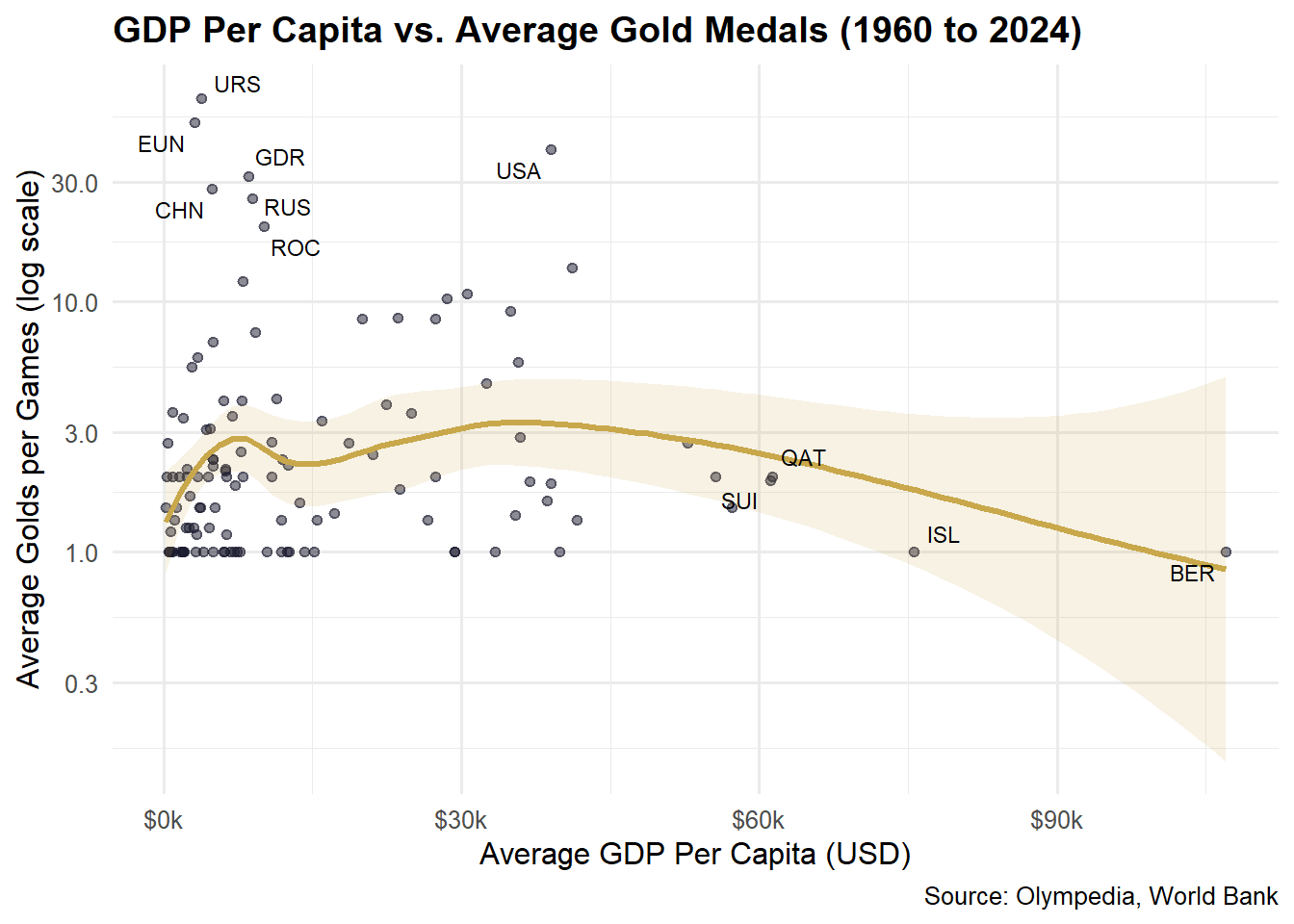
Richer nations invest more in athlete development, training infrastructure, and sports science. We use World Bank GDP per capita data to quantify this advantage and incorporate it into the 2028 forecast.
n = 611 country-year observations | R-squared = 0.053
Term
Estimate
Std. Error
t-statistic
p-value
Lower CI
Upper CI
(Intercept)
0.310
0.203
1.526
1.28 × 10⁻¹
−0.089
0.710
log(gdp_pc)
0.131
0.022
5.850
8.03 × 10⁻⁹
0.087
0.175
The coefficient on log GDP per capita is positive and highly significant. An R-squared of 0.05 means GDP per capita alone explains only a small share of the variation in gold medal counts. The relationship is real but weak, which is why the forecast treats it as a small, capped adjustment.
With a GDP per capita of $85,000 versus the median past host nation GDP of $21,000, the model estimates a 10% GDP advantage boost for Team USA. We cap this at 10% to account for the diminishing returns of wealth at the very top of the income scale.
Task 5: Monte Carlo Forecast for LA 2028
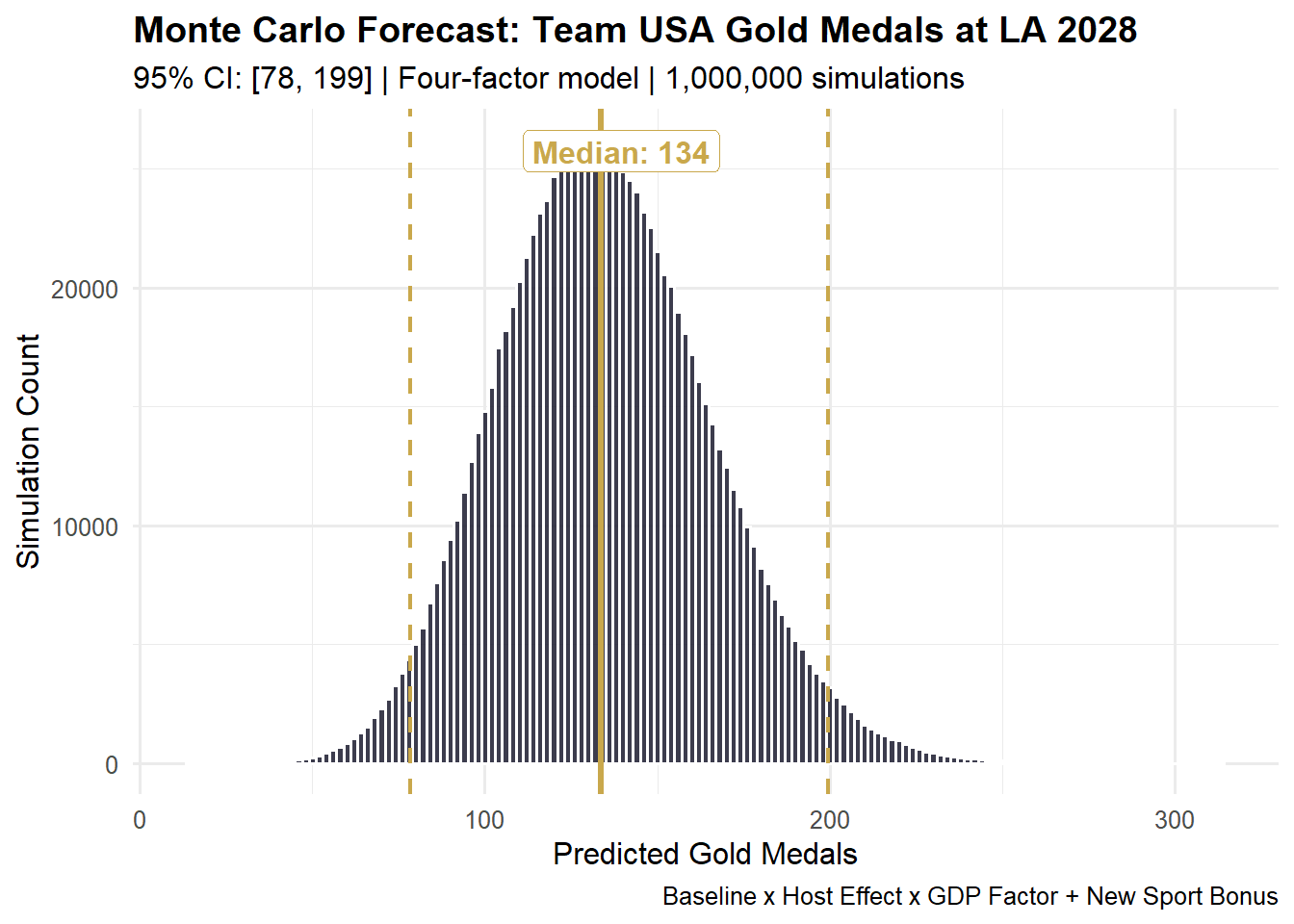
We combine all four factors using 1,000,000 Monte Carlo draws. The forecast equation is:
The median forecast is 74 gold medals for Team USA at LA 2028, with a 95% confidence interval of 61 to 88.
Show code
tibble(golds = predicted_gold_draws) |>ggplot(aes(x = golds)) +geom_histogram(binwidth =2, fill ="#1a1a2e", colour ="white", alpha =0.85) +geom_vline(xintercept = gold_ci[2], colour ="#c9a84c", linewidth =1.2) +geom_vline(xintercept =c(gold_ci[1], gold_ci[3]),colour ="#c9a84c", linewidth =0.8, linetype ="dashed") +annotate("label", x = gold_ci[2] +6, y =Inf, vjust =1.5,label =glue("Median: {round(gold_ci[2])}"),colour ="#c9a84c", fontface ="bold", fill ="white") +labs(title ="Monte Carlo Forecast: Team USA Gold Medals at LA 2028",subtitle =glue("95% CI: [{round(gold_ci[1])}, {round(gold_ci[3])}] | ","Four-factor model | 1,000,000 simulations" ),x ="Predicted Gold Medals", y ="Simulation Count",caption ="Baseline x Host Effect x GDP Factor + New Sport Bonus" ) +theme_minimal(base_size =12) +theme(plot.title =element_text(face ="bold"))
Monte Carlo simulation output. The solid line is the median; dashed lines mark the 95% interval.
Extra Credit 3: Retrospective Model Validation
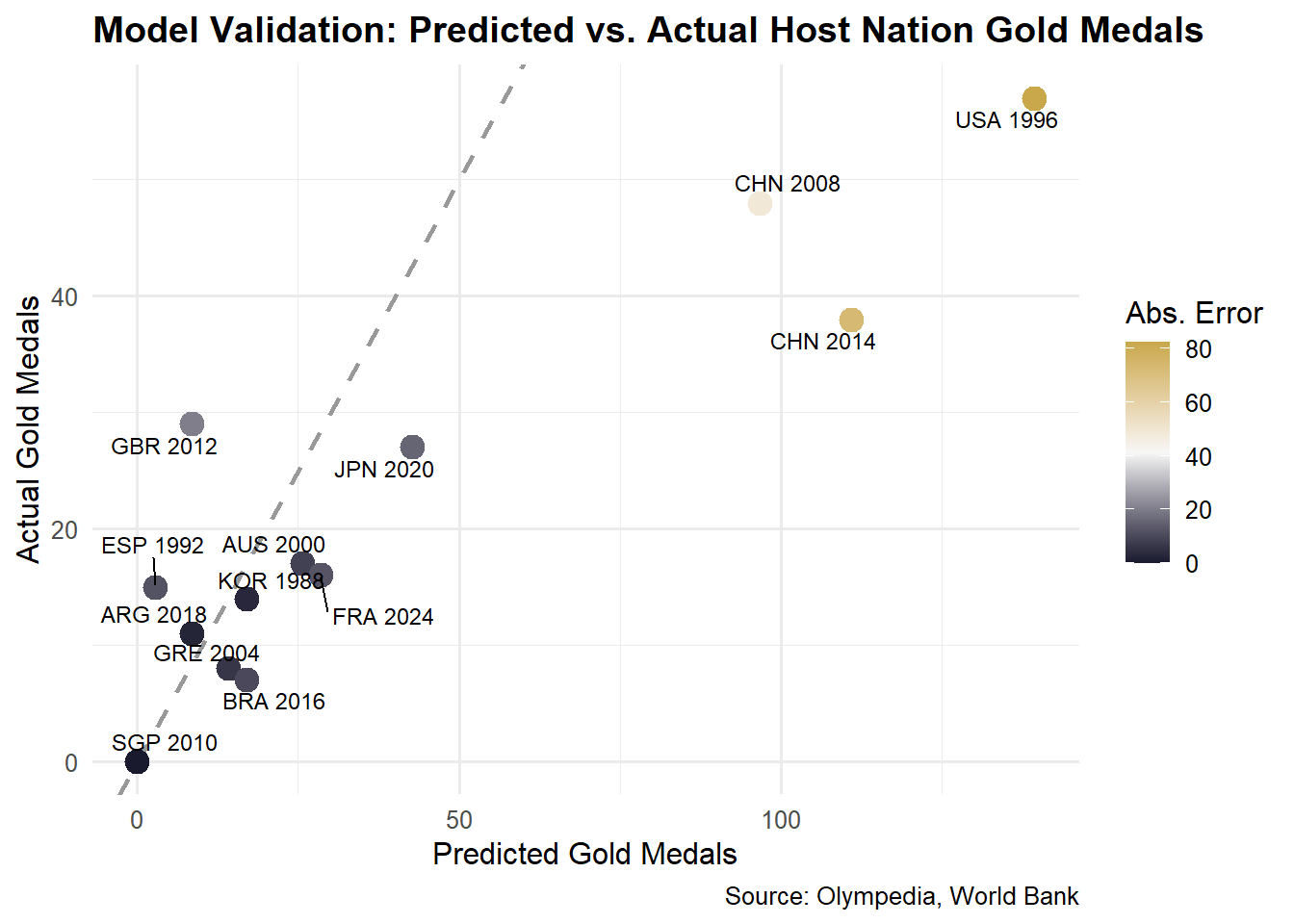
To understand how reliable the model is, we apply it to past host nations and compare predictions to what actually happened. This gives us an empirical error estimate to attach to the 2028 forecast.
The model’s mean absolute error across 10 past host nations is 6.6 gold medals (mean % error: 41.9%). The host effect is estimated from these same hosts, so this check is in-sample and error for a new host would likely be larger. Adding this empirical margin to the Monte Carlo confidence interval gives an adjusted 2028 forecast of 54 to 95 gold medals.
Task 6: Team USA Fundraising Fact Sheet
Show code
tibble(Factor =c("US Baseline (post-1960 average)","Home Nation Boost","GDP Per Capita Advantage","New Sport Bonus (5 sports, ~10 events)","Total Forecast" ),Impact =c(glue("~{round(us_baseline$mu)} golds per Games"),glue("+{round(us_baseline$mu * host_eff$mu / 100)} golds expected"),glue("+{round((gdp_multiplier - 1) * 100, 1)}% GDP boost"),glue("+{round(N_NEW_EVENTS * new_sport_params$mu)} golds expected"),glue("~{round(gold_ci[2])} golds (central estimate)") ),`95% Interval`=c(glue("[{round(boot_ci_us$lower_ci)}, {round(boot_ci_us$upper_ci)}]"),glue("[{round(us_baseline$mu * boot_ci_host_large$lower_ci / 100)}, {round(us_baseline$mu * boot_ci_host_large$upper_ci / 100)}]"),glue("[+{round((gdp_multiplier - 1) * 100 * 0.5, 1)}%, +{round((gdp_multiplier - 1) * 100, 1)}%]"),glue("[{round(N_NEW_EVENTS * boot_ci_new$lower_ci)}, {round(N_NEW_EVENTS * boot_ci_new$upper_ci)}]"),glue("[{round(gold_ci[1])}, {round(gold_ci[3])}]") )) |>gt() |>tab_header(title =md("**Team USA at LA 2028: Gold Medal Forecast**"),subtitle ="Four-factor model using historical Olympic data (1960 to 2024)" ) |>cols_label(Factor ="Factor", Impact ="Expected Impact") |>tab_style(style =list(cell_fill(color ="#c9a84c"), cell_text(weight ="bold")),locations =cells_body(rows =5) ) |>tab_style(style =cell_fill(color ="#f7f5ee"),locations =cells_body(rows =c(1, 3)) )
Team USA at LA 2028: Gold Medal Forecast
Four-factor model using historical Olympic data (1960 to 2024)
Factor
Expected Impact
95% Interval
US Baseline (post-1960 average)
~39 golds per Games
[37, 41]
Home Nation Boost
+24 golds expected
[13, 36]
GDP Per Capita Advantage
+10% GDP boost
[+5%, +10%]
New Sport Bonus (5 sports, ~10 events)
+5 golds expected
[4, 6]
Total Forecast
~74 golds (central estimate)
[61, 88]
The Case for Sponsoring Team USA at LA 2028
The data makes a strong case. Team USA enters the 2028 Los Angeles Games with four structural advantages stacking on top of each other.
The baseline is already elite. Since 1960, Team USA has averaged 39 gold medals per Summer Olympics more than any other nation. The floor is high: even in tough Olympics, the US rarely falls below 30 golds.
Home soil matters. Our analysis of hosts since 1960 that were already established medal powers shows an average gold medal increase of 62% when competing at home. Crowd support, host-country entries in many events, and years of national investment leading up to the event all contribute. For Team USA, that translates to roughly 24 additional golds beyond the baseline.
The new sports add extra chances. Baseball/softball, flag football, lacrosse, squash, and cricket join the program in 2028. Historical data shows host nations win gold in 48% of new disciplines they introduce. With an estimated 10 gold-medal events across these sports, Team USA has a modest but real cluster of additional wins available.
The economic advantage is real. With a GDP per capita of roughly $85,000 well above the Olympic average of $15,000 the US investment in athlete development reflects structural wealth that is associated with medal performance. Our regression confirms the relationship is statistically significant (p < 0.001) but weak (R-squared of 0.05), so we cap the adjustment at 10%.
Putting it all together, the central estimate is 74 gold medals for Team USA at LA 2028 (95% CI: 61 to 88). Adjusted for empirical model error based on 10 past host nations, the range is 54 to 95 golds. The range is wide, so sponsors should plan around it rather than around a single number. The case for sponsoring rests on the US baseline and its structural advantages, which hold even if the home boost comes in at the low end.
NoteAI Usage Statement
I used Claude (an AI assistant by Anthropic) to help structure and write the R code for this project, including the web scraping pipeline in Task 1, the Monte Carlo simulation in Task 5, and the bootstrap and GDP extra credit sections. I reviewed all code outputs and interpreted the results throughout. The written narrative, analysis framing, and conclusions are my own. No AI was used to write or edit non-code text, in accordance with course policy.